Here are 160 blog article titles grouped across the five health themes you requested.
領 1. Arthritis Home Remedies (32 Articles)
Arthritis
1.10 Natural Home Remedies for Arthritis Pain Relief
2.Best Anti-Inflammatory Foods for Arthritis Management
3.How to Reduce Joint Stiffness Naturally at Home
4.Herbal Remedies That May Help Arthritis Symptoms
5.Warm Compress vs Cold Therapy for Arthritic Joints
Morning Exercises to Ease Arthritis Stiffness
How Turmeric Supports Joint Health Naturally
Ginger Tea Benefits for Arthritis Pain
Essential Oils That May Soothe Joint Pain
Weight Loss Tips for Arthritis Relief
Foods That Trigger Arthritis Flare-Ups
Simple Home Stretches for Arthritis Relief
How Epsom Salt Baths Help Joint Pain
Anti-Inflammatory Diet Plan for Arthritis
Natural Ways to Improve Joint Flexibility
The Role of Hydration in Arthritis Control
Sleep Positions That Reduce Joint Pain
How Omega-3 Fatty Acids Help Arthritis
Natural Pain Relief Without Medication
Home Remedies for Knee Arthritis Pain
How to Manage Arthritis in Hands Naturally
The Best Fruits for Joint Health
Herbal Teas for Reducing Inflammation
Yoga Poses for Arthritis Relief
How Stress Affects Arthritis Symptoms
Best Natural Supplements for Joint Health
Heat Therapy Techniques for Arthritis
Anti-Inflammatory Lifestyle Habits
How to Prevent Arthritis Progression Naturally
Homemade Remedies for Swollen Joints
Natural Oils for Joint Massage Therapy
Daily Routine to Manage Arthritis Pain
六⚕️ 2. Erectile Dysfunction Home Remedies (32 Articles)
Erectile Dysfunction
1.Natural Home Remedies for Erectile Dysfunction
2.Foods That Improve Male Performance Naturally
How Exercise Improves Blood Flow and Function
Herbal Supplements That May Support ED Recovery
Stress and Erectile Dysfunction: The Hidden Link
Best Vitamins for Male Performance Health
How Sleep Affects Erectile Function
Natural Ways to Boost Testosterone Levels
Foods That Improve Circulation Naturally
Kegel Exercises for Men Explained
How Obesity Contributes to Erectile Dysfunction
Home Remedies for Improving Libido
Best Drinks for Male Vitality and Energy
How Alcohol Affects Erectile Function
The Role of Mental Health in ED
Natural Ways to Improve Stamina
Herbal Teas That May Support Male Health
Lifestyle Changes That Reverse Erectile Dysfunction
How Smoking Impacts Male Performance
Natural Oils and Traditional Remedies for ED
Foods That Boost Nitric Oxide Production
Simple Morning Habits for Male Vitality
Natural Ways to Improve Blood Circulation
How Diabetes Contributes to Erectile Dysfunction
Best Home-Based Fitness Plan for Men
Foods That Improve Hormonal Balance
How to Reduce Performance Anxiety Naturally
Natural Testosterone Boosting Diet Plan
The Role of Heart Health in Erectile Function
Best Herbs Used Traditionally for Male Vitality
How to Improve Sexual Health Naturally at Home
Long-Term Lifestyle Fixes for Erectile Dysfunction
❤️ 3. High Blood Pressure Home Remedies (32 Articles)
High Blood Pressure
Natural Ways to Lower High Blood Pressure at Home
Best Foods for Blood Pressure Control
How Salt Intake Affects Hypertension
Herbal Remedies for Blood Pressure Reduction
Daily Habits That Lower Blood Pressure Naturally
How Stress Raises Blood Pressure
Exercise Tips for Hypertension Management
Foods That Help Relax Blood Vessels
The DASH Diet Explained Simply
Natural Ways to Improve Heart Health
How Weight Loss Helps Lower Blood Pressure
Best Fruits for Hypertension Control
Garlic Benefits for Blood Pressure
How Breathing Exercises Reduce Hypertension
The Role of Potassium in Blood Pressure Control
Natural Drinks That Support Heart Health
Morning Routines for Blood Pressure Stability
Foods to Avoid with High Blood Pressure
How Sleep Impacts Hypertension
Natural Ways to Improve Circulation
Best Home Remedies for Blood Pressure Spikes
How Walking Helps Control Hypertension
The Connection Between Anxiety and Blood Pressure
Natural Supplements for Heart Health
How Caffeine Affects Blood Pressure
Lifestyle Changes to Reverse Hypertension Risk
Anti-Inflammatory Diet for Heart Health
Natural Ways to Detox Blood Vessels
How Hydration Helps Blood Pressure Control
Best Herbal Teas for Hypertension
How to Monitor Blood Pressure at Home
Long-Term Strategies for Healthy Blood Pressure
4. Fibroids Home Remedies (32 Articles)
Fibroids
Natural Remedies for Uterine Fibroids
Foods That May Help Shrink Fibroids Naturally
Hormonal Balance and Fibroid Growth Explained
Herbal Treatments for Fibroid Relief
How Diet Impacts Fibroid Development
Best Anti-Inflammatory Foods for Fibroids
Natural Ways to Manage Heavy Menstrual Bleeding
The Role of Estrogen in Fibroid Growth
Home Remedies for Fibroid Pain Relief
How Weight Affects Fibroid Risk
Herbal Teas That Support Uterine Health
Best Fruits for Hormonal Balance
Natural Ways to Support Reproductive Health
How Stress Influences Fibroid Growth
Foods to Avoid with Fibroids
Natural Detox Plans for Hormonal Balance
Exercise Benefits for Fibroid Management
How to Reduce Fibroid Symptoms Naturally
The Link Between Fibroids and Estrogen Dominance
Natural Supplements for Uterine Health
Home Remedies for Pelvic Pain
How to Balance Hormones Naturally
Best Plant-Based Diet for Fibroids
How Sleep Affects Hormonal Health
Natural Ways to Reduce Inflammation in the Uterus
Fibroid Prevention Through Lifestyle Changes
Herbal Oils for Abdominal Massage
Natural Ways to Improve Menstrual Health
How Fiber Intake Helps Fibroids
Best Morning Habits for Hormonal Balance
Natural Support for Fertility with Fibroids
Long-Term Fibroid Management Strategies
5. Peptic Ulcer Home Remedies (32 Articles)
Peptic Ulcers
1.Natural Home Remedies for Peptic Ulcers
2.Foods That Help Heal Stomach Ulcers
3.How Stress Causes Peptic Ulcers
4.Best Diet Plan for Ulcer Recovery
Herbal Remedies for Stomach Ulcer Relief
Foods to Avoid with Peptic Ulcers
How Honey Helps Heal Ulcers Naturally
The Role of H. pylori in Ulcers Explained
Natural Ways to Reduce Stomach Acid
Best Drinks for Ulcer Relief
How Probiotics Support Gut Healing
Aloe Vera Benefits for Peptic Ulcers
Anti-Inflammatory Diet for Stomach Health
How Smoking Worsens Ulcers
Natural Ways to Soothe Stomach Pain
Best Fruits for Ulcer Healing
How Spicy Foods Affect Peptic Ulcers
Home Remedies for Burning Stomach Pain
The Role of Fiber in Ulcer Recovery
Natural Gut-Healing Lifestyle Tips
How to Improve Digestion Naturally
Best Herbal Teas for Ulcer Relief
How Alcohol Impacts Stomach Ulcers
Simple Breakfast Ideas for Ulcer Patients
Natural Ways to Protect the Stomach Lining
How Sleep Affects Digestive Healing
Foods That Reduce Stomach Irritation
Long-Term Ulcer Prevention Strategies
Natural Remedies for Acid Reflux and Ulcers
How to Strengthen Digestive Health Naturally
Stress Management for Ulcer Recovery
Complete Lifestyle Plan for Peptic Ulcer Healing
If you want, I can next:
�Turn these into SEO blog outlines
Or �convert them into a 30-day content calendar
Or �rewrite them into viral TikTok scripts or Facebook posts
Category: Uncategorized
-
-

Discover powerful natural remedies for arthritis pain relief! Learn how herbs, diet, and lifestyle changes can reduce inflammation and imprinove joint health. Order herbal remedies via WhatsApp today!
Introduction
Arthritis pain can make even the simplest daily activities feel difficult. Stiff joints, swelling, and constant discomfort can affect your mobility and quality of life.
While conventional treatments exist, many people are now turning to natural remedies to reduce inflammation, ease pain, and improve joint flexibility—without harsh side effects.
In this guide, you’ll discover proven natural solutions that actually work and how to incorporate them into your daily routine.
1. Turmeric – The Powerful Anti-Inflammatory
Turmeric contains curcumin, a compound known for its strong anti-inflammatory and pain-relieving properties. It helps reduce joint swelling and stiffness.
How to use:
- Add turmeric to your meals
- Drink turmeric tea or golden milk daily
✨ CTA: Looking for a powerful herbal solution for arthritis pain? Order via WhatsApp:
👉 https://wa.me/254726530868?text=Hi%2C%20I%20would%20like%20to%20order%20herbal%20arthritis%20pain%20relief2. Ginger – Natural Pain Relief
Ginger works similarly to anti-inflammatory drugs by reducing compounds that cause pain in the body.
How to use:
- Drink ginger tea 1–2 times daily
- Add fresh ginger to meals
3. Warm and Cold Therapy
Simple temperature therapy can bring quick relief:
- Warm compress: Relaxes muscles and improves blood flow
- Cold compress: Reduces swelling and numbs pain
Tip: Alternate between hot and cold for best results.
4. Epsom Salt Baths – Relax and Soothe
Epsom salt contains magnesium, which helps relax muscles and reduce inflammation.
How to use:
- Add 1–2 cups of Epsom salt to warm bath water
- Soak for 15–20 minutes
5. Stay Active – Gentle Movement Matters
It may feel counterintuitive, but movement helps reduce stiffness and improve flexibility.
- Try walking, stretching, or yoga
- Avoid long periods of inactivity
6. Maintain a Healthy Weight
Excess weight puts additional pressure on joints, especially knees and hips. Losing even a small amount of weight can significantly reduce pain.
✨ CTA: Need natural support for weight management and joint health? Order via WhatsApp:
👉 https://wa.me/254726530868?text=Hi%2C%20I%20would%20like%20to%20order%20herbal%20joint%20and%20weight%20support
7. Herbal Oils for Joint Massage
Massaging joints with herbal oils improves circulation and reduces stiffness. Popular options include:
- Eucalyptus oil
- Peppermint oil
- Herbal blends designed for joint relief
8. Anti-Inflammatory Diet
Your diet plays a major role in managing arthritis pain.
Eat more of:
- Leafy greens
- Fruits rich in antioxidants
- Healthy fats (avocado, nuts, seeds)
Avoid:
- Processed foods
- Excess sugar
- Fried foods
9. Omega-3 Fatty Acids – Joint Protection
Omega-3s help reduce inflammation and improve joint mobility.
Sources include:
- Flaxseeds
- Chia seeds
- Fatty fish
10. Herbal Support for Long-Term Relief
Natural herbal formulations can help reduce inflammation, improve mobility, and support long-term joint health.
✨ CTA: Ready to relieve arthritis pain naturally? Order your herbal remedy via WhatsApp now:
👉 https://wa.me/254726530868?text=Hi%2C%20I%20would%20like%20to%20order%20herbal%20arthritis%20relief%20products
Conclusion: Take Control of Your Joint Health Naturally
Arthritis pain doesn’t have to control your life. By combining natural remedies like turmeric, ginger, herbal oils, and lifestyle changes, you can reduce inflammation, ease pain, and regain mobility.
💡 Quick Tip: Consistency is key. Small daily habits lead to long-term relief and better joint health.
- How Exercise Improves Blood Flow and Function|Wordplant Living SystemDiscover how exercise improves blood flow and body function naturally. Learn how regular physical activity supports healthy circulation, heart health, energy levels, brain function, erectile function, and overall wellbeing through simple daily movement. Why Regular Movement Is One of the Most Powerful Natural Ways to Support Circulation and Overall Health When people think about exercise,… Read more: How Exercise Improves Blood Flow and Function|Wordplant Living System
- How Stress Causes Peptic Ulcers|Wordplant Living SystemThe Hidden Connection Between Chronic Stress, Digestive Health, and Stomach Ulcers Have you ever noticed that your stomach seems to react when life becomes overwhelming? Perhaps you experience a burning sensation after a stressful day. Maybe your appetite changes during difficult periods. Or perhaps persistent digestive discomfort appears when you’re carrying emotional burdens that seem… Read more: How Stress Causes Peptic Ulcers|Wordplant Living System
- Home Remedies for Improving Libido|Wordplant Living SystemDiscover home remedies for improving libido naturally through diet, lifestyle changes, herbs, sleep, and stress management. Learn how to support sexual desire, energy, hormone balance, and overall vitality using simple, natural approaches. Restoring Desire, Energy, and Intimacy Through Natural Daily Habits Low libido is more common than many people realize, and it can affect both… Read more: Home Remedies for Improving Libido|Wordplant Living System
- Ginger Tea Benefits for Arthritis Pain|Wordplant Living SystemDiscover the potential benefits of ginger tea for arthritis pain and joint health. Learn how this natural herbal drink may support healthy inflammatory responses, improve circulation, ease stiffness, and promote overall wellness as part of a balanced lifestyle. A Warm Cup of Nature’s Goodness for Healthier Joints and Better Mobility For centuries, ginger has been… Read more: Ginger Tea Benefits for Arthritis Pain|Wordplant Living System
- How Turmeric Supports Joint Health Naturally|Wordplant Living SystemLearn how turmeric supports joint health naturally. Discover the potential benefits of curcumin for healthy inflammatory responses, mobility, antioxidant protection, and overall wellness, plus practical ways to include turmeric in your daily diet. Discover the Golden Spice That Has Helped Generations Promote Mobility, Ease Stiffness, and Support Healthy Inflammatory Responses If you’ve ever searched for… Read more: How Turmeric Supports Joint Health Naturally|Wordplant Living System
-
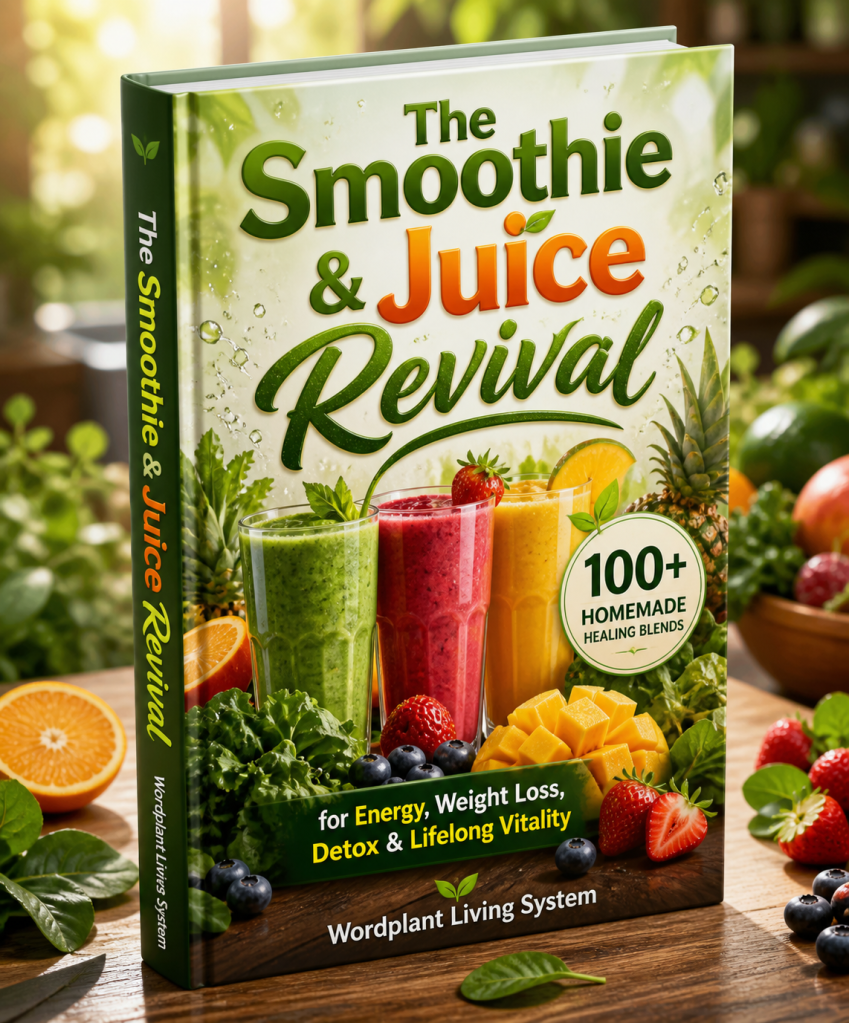
Introduction
What if improving your energy, boosting your immunity, losing weight, and detoxing your body didn’t require expensive supplements or complicated diets—but simply a daily glass of fresh, natural smoothies and juices?
The Smoothie & Juice Revival: 100+ Homemade Healing Blends for Energy, Weight Loss, Detox & Lifelong Vitality is a practical guide designed to help you restore your health using simple ingredients you can find in your local market. Inside, you’ll discover easy-to-make recipes that support energy, digestion, immunity, fat loss, and full-body cleansing—naturally and affordably.
This book is perfect for anyone who feels tired, sluggish, stressed, or stuck in unhealthy eating habits and wants a realistic way to restart their health journey without extreme diets.
What You Will Learn Inside the Book
- How smoothies and juices support natural healing in the body
- Energy-boosting blends for daily vitality
- Weight loss and fat-burning smoothie recipes
- Immune-strengthening natural drinks
- Detox and cleansing juice protocols
- Simple step-by-step guidance for long-term wellness
Whether you are a beginner or already health-conscious, this book gives you a structured system you can follow daily to feel lighter, healthier, and more energized.
Start Your Health Transformation Today
You don’t need to wait to begin your journey to better health. Your body responds to what you feed it—starting now.
📲 To order your copy, WhatsApp: 0726 530 868 / 0733 437 852 with the words “SMOOTHIE”.
💳 Payment via M-PESA available (fast and convenient across Kenya)Take the first step toward a healthier, more vibrant you—one smoothie at a time.
-

Wellness Journey Discover the possibility of reversal in biological systems. Learn how the body can adapt to supportive conditions, reduce inflammation, restore energy, and rebalance function over time through consistent lifestyle and environmental changes.
Introduction
One of the most powerful yet often overlooked truths about the human body is this: it is not fixed.
The body is dynamic, responsive, and constantly adapting to its environment. Just as it can shift toward imbalance under prolonged stress, it can also move back toward stability when conditions improve.
This concept—the possibility of reversal—offers a more hopeful and realistic understanding of health.
It reminds us that decline is not always a one-way path. In many cases, the body can change direction.
Adaptation Works in Both Directions
Biological systems are built on adaptation.
When exposed to repeated stress—whether from poor nutrition, lack of sleep, emotional strain, or environmental toxins—the body adjusts in order to cope. These adjustments may initially help survival, but over time they can contribute to imbalance and symptoms.
However, adaptation is not limited to negative conditions.
When the environment shifts in a supportive direction, the body begins to adapt again—this time toward restoration.
This means:
- Systems that were overworked can begin to recover
- Processes that were disrupted can begin to stabilize
- Functions that were suppressed can gradually return
The same adaptability that contributes to imbalance also creates the potential for healing.
The Body Responds to Consistent Signals
One of the key principles behind reversal is consistency.
The body does not respond to isolated actions as much as it responds to repeated patterns.
For example:
- One healthy meal does not transform metabolism, but consistent nutrition can
- One good night of sleep does not restore full energy, but regular sleep patterns can
- One stress-free day does not reset the nervous system, but ongoing stress management can
Over time, these repeated positive signals begin to influence how the body allocates its resources.
Instead of focusing primarily on survival and defense, it begins to shift toward repair and balance.
What Happens When Conditions Improve
As supportive conditions become consistent, several changes may begin to occur within the body.
Inflammation Can Decrease
Chronic inflammation is often a response to ongoing stress, poor diet, or environmental burden. When these triggers are reduced, the body may gradually lower its inflammatory response.
This can lead to improvements in pain, swelling, and overall comfort.
Energy Levels Can Stabilize
Fatigue is often linked to stress, poor sleep, or metabolic imbalance. When these factors are addressed, energy production systems can begin to function more efficiently.
Instead of short bursts followed by crashes, energy becomes more stable throughout the day.
Sleep Quality Can Improve
Sleep is deeply connected to both physical and mental health. When stress levels are reduced and daily rhythms become more consistent, sleep patterns often improve naturally.
Better sleep further supports recovery, creating a positive cycle.
Metabolic Function Can Rebalance
Metabolism is not just about weight—it involves how the body processes and uses energy.
With improved nutrition, movement, and hormonal balance, metabolic processes can become more efficient and stable over time.
Why Reversal Takes Time
One of the most important aspects of this process is understanding that reversal is not immediate.
The body does not shift into imbalance overnight, and it does not return to balance instantly.
Time is required because:
- Cells need to repair and regenerate
- Systems need to recalibrate
- Hormonal patterns need to stabilize
- Long-standing habits need to change
This gradual process is not a weakness—it is a reflection of how deeply the body works to maintain stability.
Patience and consistency are essential.
Not Every Condition Is Fully Reversible
While the possibility of reversal is real, it is important to approach it with balance and realism.
Not every condition can be fully reversed in every individual. Factors such as:
- The duration of the condition
- The extent of tissue or system damage
- Genetic influences
- Age and overall health status
can all influence outcomes.
However, even when full reversal is not possible, improvement is often achievable.
Reducing symptom severity, slowing progression, and improving quality of life are all meaningful outcomes.
The Body Is Not Locked Into Decline
A common belief in health is that once the body begins to decline, it cannot change course.
But this perspective overlooks the body’s adaptive nature.
The body is not locked into a single trajectory.
It responds continuously to:
- What we eat
- How we move
- How we rest
- How we manage stress
- The environment we live in
When these inputs change, the body responds.
Over time, these responses can accumulate into meaningful shifts in health.
The Environment Shapes the Outcome
Every day, the body receives signals from its environment.
These signals come from:
- Nutrition and hydration
- Physical activity
- Sleep patterns
- Emotional experiences
- Environmental exposures
Each of these influences how the body prioritizes its internal processes.
If the environment consistently signals stress, the body prioritizes defense.
If the environment consistently signals support, the body begins to prioritize repair.
This is the foundation of reversal.
Building a Supportive Environment for the Body
Creating conditions for reversal does not require perfection. It requires consistency.
Some foundational shifts include:
- Choosing more whole, nutrient-dense foods
- Establishing regular sleep routines
- Reducing chronic stress where possible
- Incorporating daily movement
- Minimizing unnecessary toxin exposure
- Creating time for mental and emotional recovery
Each of these changes sends a signal to the body.
Over time, these signals add up.
Small Changes, Compounding Effects
One of the most encouraging aspects of biological adaptation is that small, consistent changes can lead to significant outcomes.
A single action may seem minor, but when repeated daily, it becomes a pattern.
And patterns shape physiology.
This means that improvement does not always require dramatic transformation. It often begins with simple, sustainable adjustments.
A More Hopeful View of Health
Understanding the possibility of reversal offers a more balanced and hopeful view of health.
It acknowledges that:
- The body can move toward imbalance
- The body can also move back toward balance
- Change is possible, even if gradual
- Improvement is often within reach
This perspective encourages action, patience, and consistency rather than resignation.
Final Thoughts
The possibility of reversal is rooted in one simple truth: the body adapts.
It adapts to stress, but it also adapts to support.
When conditions improve consistently, the body begins to reallocate its resources—shifting from survival toward restoration.
This process is not instant, and it is not always complete in every case. But it is real.
The body is not fixed. It is responsive.
And over time, it reflects the environment it is given.
📖 Get Your 7-Day Natural Reset Guide FREE
Start immediately with a simple guide that shows you:
✔ Morning & evening routines
✔ Foods that support healing
✔ Herbal wellness basics
✔ Lifestyle corrections
✔ Mistakes to avoidSend the word GUIDE to WhatsApp +254 726 530 868
-

Wellness Awareness Discover the beginning of integration in healthcare—how understanding symptom-based medicine helps build a more complete view of health. Learn why true healing comes from awareness, not opposition, and how combining approaches supports deeper, lasting wellness.
Introduction
Health is often discussed in separate categories—modern medicine on one side, and holistic or lifestyle-based approaches on the other. But real human health does not exist in compartments. The body does not separate itself into systems of opposing philosophies. It functions as one interconnected whole.
This is where the idea of integration begins.
Integration is not about rejecting what already exists. It is about understanding it more deeply, appreciating its strengths, and recognizing where additional support may be needed.
In the context of symptom-based medicine, integration begins when we see treatment not as the whole picture, but as one important layer within a broader system of care.
Understanding Symptom-Based Medicine as a Starting Point
Symptom-based medicine plays a vital role in modern healthcare. It provides relief, stability, and often life-saving intervention in acute situations.
When a person experiences pain, infection, inflammation, or distress, symptom-focused care can:
- Reduce suffering quickly
- Stabilize urgent conditions
- Prevent complications
- Support recovery in critical moments
These strengths make it an essential part of healthcare systems worldwide.
However, understanding its role clearly also reveals something important: it is often designed to respond to what is visible, not always to investigate everything that led to it.
This understanding does not diminish its value—it simply defines its scope.
And once we understand the scope, we can begin to build beyond it.
Recognizing Strengths Without Overdependence
Integration begins with clarity.
When we recognize where symptom-based care excels, we can use it appropriately without over-relying on it for every layer of health concern.
Its strengths include:
- Fast response in acute conditions
- Standardized treatment protocols
- Effective symptom relief
- Support in emergency care situations
These are powerful and necessary contributions to health and survival.
But when used as the only lens through which health is viewed, it may not always address the deeper contributors to chronic imbalance.
This is not a flaw—it is a limitation of focus.
And every system of care has a focus.
Recognizing Limitations Without Rejection
The next step in integration is not criticism—it is awareness.
When we understand that symptoms are often expressions of deeper imbalance, we begin to see that:
- Not all causes are immediately visible
- Some conditions develop over long periods
- Lifestyle and environment play major roles
- Emotional and biological systems are deeply connected
This awareness does not mean abandoning symptom-based care. It means expanding the view beyond it.
In other words, we stop seeing one approach as the whole solution and begin seeing it as part of a larger process.
This Is Where Integration Begins
Integration does not begin with systems competing. It begins with systems cooperating.
It is not:
- Modern medicine versus natural approaches
- Treatment versus lifestyle change
- Science versus holistic understanding
Instead, it becomes a layered model of care where each approach contributes what it does best.
Symptom-based care addresses immediate needs.
Lifestyle and root-cause approaches address underlying patterns.
Together, they form a more complete picture.
This is integration.
Not in Opposition
One of the biggest barriers to better health understanding is the idea that different approaches must be in opposition.
But the body does not operate in opposition. It operates in coordination.
The heart does not compete with the lungs. The nervous system does not oppose the digestive system. They function together to maintain balance.
Similarly, health approaches do not need to compete. They can complement each other when understood properly.
Integration begins when we stop asking, “Which approach is right?” and start asking, “How do these approaches work together?”
Not in Rejection
Integration also does not require rejection of existing systems.
Rejecting symptom-based medicine would ignore its essential role in:
- Emergency care
- Infection control
- Pain management
- Surgical intervention
- Acute stabilization
Instead, integration respects its value while also recognizing that long-term wellness often requires additional layers of support.
Rejection narrows perspective.
Integration expands it.
But in Awareness
At the heart of integration is awareness.
Awareness that:
- The body is complex and interconnected
- Symptoms are signals, not just problems
- Health is influenced by multiple systems
- No single approach holds all answers
Awareness allows us to choose wisely, respond appropriately, and build a more balanced relationship with health.
It is not about choosing sides. It is about seeing clearly.
True Healing Goes Beyond What Is Visible
Many health approaches focus primarily on what can be observed—pain, inflammation, visible symptoms, or diagnostic results.
But true healing often requires attention to what is not immediately visible:
- Nutritional imbalances
- Long-term stress patterns
- Emotional history and mental load
- Environmental exposures
- Lifestyle rhythms and habits
These hidden layers often shape the visible outcomes.
When we address only what we can see, we may miss what is driving the process beneath the surface.
Understanding What Lies Beneath
To move toward deeper health understanding, we must become curious about what lies beneath symptoms.
Instead of stopping at the surface, we begin to ask:
- What systems are under stress?
- What patterns have developed over time?
- What internal balance is being disrupted?
- What external influences are contributing?
These questions open the door to more complete healing strategies.
They do not replace symptom-based care—they expand it.
The Foundation of Integrated Health Thinking
Integrated health thinking is built on a simple principle:
No single layer tells the full story.
- Symptoms tell us what is happening now
- Diagnostics help us understand how the body is functioning
- Lifestyle patterns reveal why the imbalance may be occurring
When all three are considered together, health becomes more understandable and more manageable.
Final Thoughts
The beginning of integration is not a dramatic shift—it is a quiet change in perception.
It is the moment we stop viewing health through a single lens and start seeing it as a connected system of influences, responses, and adaptations.
Symptom-based medicine remains valuable and necessary. But when combined with deeper awareness of root causes and lifestyle factors, it becomes part of a more complete and effective approach to wellness.
True healing is not only about removing what is visible.
It is also about understanding what lies beneath it.
And that understanding is where integration begins.
-

Preventive Care Explore a shift in perspective on symptom-based medicine and learn how clarity—not criticism—helps deepen health understanding. Discover how asking better questions about symptoms, lifestyle, and the environment expands treatment beyond relief toward true restoration.
Introduction
In modern healthcare, symptom-based medicine is often the first and most important point of contact. It provides relief, stabilizes urgent conditions, and helps manage discomfort effectively. However, as our understanding of health evolves, a deeper perspective becomes increasingly valuable.
This shift is not about rejecting established medical approaches. It is about expanding awareness.
It is about moving from a narrow focus on symptom control alone to a broader understanding of what the body is communicating and why.
This is what we mean by a shift in perspective.
Clarity, Not Criticism
Recognizing the strengths and limitations of symptom-based medicine is often misunderstood. It is not an act of criticism. It is an act of clarity.
Clarity allows us to see:
- Where a treatment is highly effective
- Where it provides immediate and necessary support
- Where it may need to be complemented by other approaches
- Where deeper investigation may be helpful
Without clarity, we may either over-rely on one approach or dismiss it entirely. Both extremes limit understanding.
With clarity, we begin to see health more completely.
Asking Better Questions About the Body
A shift in perspective begins when we move from automatic responses to thoughtful inquiry.
Instead of focusing only on symptom removal, we begin to ask more meaningful questions:
- What is the body trying to communicate through this symptom?
- Why did this imbalance develop in the first place?
- What systems in the body may be under strain?
- Is immediate suppression enough, or is deeper support needed?
- What patterns in daily life may be contributing to this condition?
These questions do not delay treatment—they deepen understanding.
They help ensure that care is not only reactive, but also reflective.
What the Body Communicates Through Symptoms
Symptoms are often interpreted as problems to eliminate as quickly as possible. While relief is important, symptoms can also be viewed as signals.
For example:
- Fatigue may signal nutrient depletion or chronic stress
- Headaches may reflect tension, dehydration, or nervous system overload
- Digestive issues may indicate imbalance in gut function or diet
- Skin conditions may reflect internal detoxification stress
In each case, the symptom is not just an isolated issue—it is part of a broader message.
Understanding this message does not replace treatment. It informs it.
Immediate Suppression vs. Deeper Support
One of the key questions in this shift is whether immediate symptom suppression is sufficient on its own.
In some situations, immediate relief is essential and appropriate. Pain, infection, or acute distress often require fast intervention.
However, in many chronic or recurring conditions, we must also consider deeper support.
This includes:
- Nutritional correction
- Stress regulation
- Sleep restoration
- Environmental adjustments
- Emotional and lifestyle changes
The goal is not to choose one or the other, but to recognize when both are needed.
The Role of Lifestyle, Nutrition, and Environment
Health does not develop in isolation. It is shaped continuously by daily life.
Three major influences often play a central role in long-term health patterns:
Lifestyle
Daily habits such as movement, rest, stress response, and routine significantly affect bodily balance.
Nutrition
Food provides the raw materials for energy, repair, and regulation. Poor nutritional input can gradually weaken multiple systems.
Environment
Exposure to toxins, pollution, and even social or emotional environments can influence physiological function.
When symptoms appear, these factors are often part of the broader context. Addressing them can support more sustainable outcomes.
Structuring Treatment for Relief and Restoration
A more complete approach to health does not discard symptom relief. Instead, it structures care in layers.
Layer 1: Relief
Immediate interventions that reduce discomfort and stabilize the condition.
Layer 2: Support
Approaches that help the body recover balance, such as nutrition, hydration, and rest.
Layer 3: Restoration
Long-term changes that address root causes and strengthen resilience.
This layered structure ensures that care is not only focused on how a person feels today, but also on how their health evolves over time.
Expanding, Not Replacing, Conventional Medicine
A shift in perspective does not suggest replacing conventional medicine. Instead, it expands its context.
Conventional medicine remains essential for:
- Emergency situations
- Acute infections
- Surgical needs
- Diagnostic precision
- Symptom stabilization
At the same time, broader health approaches can add value by addressing:
- Lifestyle-related causes
- Preventive strategies
- Long-term balance
- System-wide support
When combined, these approaches create a more complete health framework.
From Reaction to Understanding
Much of modern healthcare is reactive—it responds to symptoms after they appear.
A shifted perspective introduces a more proactive mindset:
- What patterns are developing before symptoms appear?
- How can imbalance be corrected earlier?
- What supports long-term resilience?
This does not eliminate reactive care. It complements it with awareness and prevention.
Why This Shift Matters
This shift in perspective matters because many health challenges today are not simple or isolated. They are complex, multi-factorial, and long-term.
Without broader understanding, treatment may focus only on surface expression. With broader understanding, we begin to see patterns, connections, and root influences.
This leads to:
- More informed decisions
- More personalized care
- More sustainable outcomes
- Better collaboration between different health approaches
Final Thoughts
A shift in perspective is not about choosing sides. It is about choosing clarity.
It allows us to appreciate the value of symptom-based medicine while also recognizing the importance of deeper investigation into lifestyle, nutrition, environment, and long-term patterns.
By asking better questions, we move beyond surface-level understanding and into a more complete view of health.
True progress in health does not come from replacing one approach with another.
It comes from expanding the way we see.
And that expansion begins with perspective.
-

Wellness Education Discover how symptoms are not enemies but powerful messengers of imbalance in the body. Learn how nutrition, stress, toxins, sleep, and emotions influence health and how to restore natural balance through holistic lifestyle practices.
Introduction
In modern life, the human body is constantly exposed to pressures it was never designed to handle in excess. Processed foods, chronic stress, environmental toxins, disrupted sleep patterns, emotional strain, and sedentary lifestyles all combine to push the body beyond its natural equilibrium.
When this overload continues for weeks, months, or even years, the body begins to respond. These responses are what we commonly call symptoms.
Headaches, fatigue, digestive issues, skin problems, anxiety, inflammation, hormonal changes, and even chronic diseases do not appear randomly. They are signals. They are the body’s way of communicating that something is out of balance.
Understanding this perspective changes everything. Instead of fearing symptoms or rushing only to suppress them, we begin to listen. We begin to interpret the body’s language.
This shift—from fighting symptoms to understanding them—is one of the most powerful steps toward long-term health restoration.
The Body Is Always Seeking Balance
The human body is designed with a remarkable ability called homeostasis—the ability to maintain internal stability despite external changes.
It regulates temperature, blood pressure, hormone levels, hydration, and countless other processes automatically. Even when we make unhealthy choices, the body works tirelessly to compensate.
However, there is a limit.
When stressors accumulate faster than the body can recover, balance begins to break down. This is not sudden—it is gradual.
At first, the body adapts quietly. You may feel “mostly fine.” But underneath, systems are working harder:
- The liver processes more toxins than usual
- The nervous system remains in a stressed state
- The digestive system slows or becomes inflamed
- Hormones become dysregulated
- The immune system becomes overactive or weakened
Eventually, the body can no longer compensate silently. That is when symptoms appear.
Symptoms Are Not the Problem—They Are the Signal
One of the biggest misconceptions in modern health is treating symptoms as the disease itself. In reality, symptoms are often protective responses.
For example:
- Fever helps the body fight infection
- Inflammation brings immune cells to areas of injury
- Fatigue forces rest and recovery
- Pain prevents further damage
- Skin eruptions help eliminate toxins
From this perspective, symptoms are not random malfunctions. They are intelligent responses designed to protect and restore balance.
When we suppress symptoms without addressing the root cause, we may silence the signal—but the underlying imbalance remains.
This is why many health challenges return or worsen over time when only symptoms are treated.
The Hidden Causes of Bodily Imbalance
To understand symptoms, we must look deeper into what creates imbalance in the first place. Most chronic symptoms can be traced back to a combination of five core stressors.
1. Poor Nutrition
Modern diets are often high in refined sugars, processed fats, chemical additives, and low in essential nutrients.
When the body lacks vitamins, minerals, and enzymes, it cannot perform essential functions efficiently. This leads to fatigue, inflammation, hormonal imbalance, and weakened immunity.
Food is not just fuel—it is information for the body. Poor food choices send confusing signals to cells, disrupting normal function.
2. Chronic Stress
Stress is not inherently harmful. Short-term stress can enhance performance and focus.
The problem arises when stress becomes constant.
Financial pressure, emotional conflict, work overload, and unresolved trauma keep the nervous system in a prolonged “fight or flight” state.
In this condition:
- Digestion slows
- Hormones become imbalanced
- Sleep quality declines
- Blood pressure rises
- Inflammation increases
Over time, chronic stress becomes a silent driver of disease.
3. Environmental Toxins
We live in an environment filled with invisible burdens:
- Air pollution
- Pesticides and chemicals in food
- Heavy metals in water
- Household cleaning agents
- Synthetic personal care products
The body has detoxification systems, mainly the liver, kidneys, skin, and lungs. But when exposure exceeds capacity, toxins accumulate.
This can manifest as skin issues, brain fog, fatigue, and immune dysfunction.
4. Lack of Sleep and Recovery
Sleep is not just rest—it is repair.
During deep sleep, the body:
- Repairs tissues
- Balances hormones
- Detoxifies the brain
- Strengthens the immune system
When sleep is consistently poor or insufficient, the body remains in a state of incomplete recovery.
Over time, this leads to exhaustion, poor focus, weight gain, and increased disease risk.
5. Emotional and Mental Strain
Emotions are not separate from the body. They directly influence physiological processes.
Unprocessed grief, anxiety, anger, or long-term emotional suppression can create physical tension and inflammation.
The nervous system does not distinguish between physical and emotional threats. It responds to both in similar ways.
This is why emotional healing is often a missing piece in physical recovery.
How Symptoms Begin to Form
When these stressors accumulate, the body begins shifting through stages:
- Adaptation Stage: The body compensates internally. No obvious symptoms yet.
- Warning Stage: Mild symptoms appear—fatigue, bloating, headaches, irritability.
- Compensation Breakdown: Symptoms become frequent or persistent.
- Chronic Imbalance: Multiple systems are affected.
Most people only notice their health when they reach the third or fourth stage. But the process often begins long before symptoms become obvious.
Listening to the Body Instead of Fighting It
Healing begins when we change our relationship with symptoms.
Instead of asking, “How do I get rid of this symptom quickly?” we begin asking:
- What is my body trying to communicate?
- What imbalance led to this condition?
- What systems are under stress?
- What lifestyle factors need adjustment?
This shift transforms health from reactive to proactive.
Restoring Balance Naturally
True healing is not about forcing the body—it is about supporting its natural intelligence.
Here are foundational ways to restore balance:
Nourish the Body Properly
Focus on whole, nutrient-dense foods such as vegetables, fruits, healthy fats, clean proteins, and herbs. Reduce processed foods that burden the system.
Reduce Stress Load
Incorporate daily practices that calm the nervous system—breathing exercises, walking, meditation, or quiet time.
Support Detoxification
Increase hydration, eat fiber-rich foods, and support liver-friendly nutrition. Sweat through movement or sauna if available.
Prioritize Deep Sleep
Create a consistent sleep schedule, reduce screen exposure at night, and maintain a calming bedtime routine.
Address Emotional Health
Talk, journal, reflect, or seek support when needed. Emotional release is a form of physical healing.
The Body Wants to Heal
One of the most important truths in health is this: the body is always trying to return to balance.
Even when symptoms feel overwhelming, they are part of a larger correction process. The body does not work against itself—it works for survival and restoration.
When we support it instead of suppressing it, healing becomes more natural, gradual, and sustainable.
Final Thoughts
Symptoms are not the end of health—they are the beginning of awareness.
They are messages written in the language of the body, asking for attention, correction, and care.
When we learn to interpret these signals instead of ignoring or silencing them, we step into a deeper level of health understanding.
True wellness is not just the absence of symptoms. It is the presence of balance, energy, clarity, and resilience.
And that begins with listening.
-

Gut Health Learn how to heal your gut naturally using food, herbs, and lifestyle changes that restore digestion, reduce inflammation, and support long-term gut health.
Introduction
Your gut is more than a digestive organ.
It is the foundation of your overall health—affecting immunity, energy, mood, and even inflammation levels in the body.
When the gut is unhealthy, the body often shows it through:
- Bloating
- Fatigue
- Food sensitivities
- Skin issues
- Irregular digestion
The good news is that the gut has a powerful ability to heal when given the right conditions.
This guide explores how to heal your gut naturally using simple, practical steps that support long-term balance.
Why Gut Health Matters
The gut is home to trillions of microorganisms that form your microbiome.
When balanced, they:
- Support digestion
- Strengthen immunity
- Reduce inflammation
- Improve nutrient absorption
When imbalanced, it can contribute to conditions such as Peptic Ulcer Disease and other digestive disorders.
1. Remove Gut Irritants
Healing begins by reducing what harms the gut.
Common Irritants:
- Processed foods
- Excess sugar
- Alcohol
- Artificial additives
- Highly refined oils
Why It Matters:
These substances disrupt gut bacteria and increase inflammation.
2. Eat Whole, Natural Foods
Food is the most powerful tool for gut healing.
Best Foods:
- Vegetables
- Fruits
- Whole grains
- Healthy fats
- Lean proteins
Benefits:
- Nourishes gut bacteria
- Reduces inflammation
- Supports digestion
3. Increase Fiber Intake
Fiber feeds beneficial gut bacteria.
Sources:
- Leafy greens
- Beans
- Fruits
- Seeds
Benefits:
- Improves bowel movement
- Supports detoxification
- Balances gut microbiome
4. Use Gut-Healing Herbs
Certain herbs have been traditionally used in systems like Ayurveda and Traditional Chinese Medicine to support digestion.
Key Herbs:
- Ginger
- Turmeric (rich in Curcumin)
- Peppermint
- Chamomile
Benefits:
- Reduce inflammation
- Soothe the digestive tract
- Improve gut function
5. Support Healthy Gut Bacteria
A balanced microbiome is essential for healing.
Probiotic Foods:
- Yogurt
- Fermented vegetables
- Kefir
Benefits:
- Restore gut balance
- Improve digestion
- Strengthen immunity
6. Reduce Inflammation
Chronic inflammation affects gut function and healing.
It is linked to conditions like Arthritis and digestive disorders.
Anti-Inflammatory Strategies:
- Eat whole foods
- Avoid processed sugars
- Use herbs like turmeric and ginger
7. Manage Stress Effectively
The gut and brain are deeply connected.
Stress can:
- Slow digestion
- Disrupt gut bacteria
- Increase inflammation
Helpful Practices:
- Deep breathing
- Walking
- Meditation
- Rest
8. Improve Digestion Through Eating Habits
How you eat is just as important as what you eat.
Better Habits:
- Eat slowly
- Chew thoroughly
- Avoid overeating
- Eat in a relaxed state
9. Stay Hydrated
Water is essential for digestion.
Benefits:
- Supports nutrient absorption
- Prevents constipation
- Helps gut detoxification
10. Get Enough Sleep
Sleep is when the body repairs itself—including the gut.
Lack of Sleep Can Cause:
- Gut imbalance
- Increased inflammation
- Poor digestion
11. Limit Unnecessary Antibiotics
While sometimes necessary, antibiotics can disrupt gut bacteria.
Why It Matters:
They may reduce both harmful and beneficial bacteria, affecting gut balance.
12. Move Your Body Daily
Physical activity supports gut health.
Benefits:
- Improves digestion
- Reduces bloating
- Supports microbiome balance
How Gut Healing Happens
Gut healing is not instant.
It happens through:
- Removing irritants
- Adding supportive foods
- Restoring balance
- Reducing stress
Consistency is key.
The Bigger Picture of Gut Health
A healthy gut influences:
- Energy levels
- Immune system
- Mental clarity
- Inflammation levels
When the gut improves, the whole body benefits.
Final Thoughts
Healing your gut naturally is possible, but it requires patience and consistency.
By focusing on:
- Whole foods
- Herbal support
- Stress reduction
- Healthy habits
You create the right environment for your body to heal itself.
Call to Action
Start your gut healing journey with our FREE 7-Day Natural Reset Guide.
Inside you’ll discover: ✔ Gut-friendly foods
✔ Herbal healing routines
✔ Daily lifestyle practices👉 Click here: https://wa.me/254726530868
Type GUIDE to receive it instantly. -

Natural Health Discover what nature has always provided for human health—from whole foods and movement to healing plants—and how reconnecting can restore balance naturally.
Introduction
Nature has never stopped providing.
Despite the rapid rise of modern life—with its convenience, technology, and speed—the foundation of human health has remained unchanged. The earth still produces nourishing food. The environment still encourages movement. Natural cycles still regulate rest and recovery. Plants still contain powerful compounds that support the body’s internal systems.
Nothing essential has been lost.
Only the connection to it has been reduced.
And in that disconnection, many of today’s health challenges have taken root.
But the good news is this:
What the body needs… still exists.
It has always existed.
The question is no longer “What is missing?”
The real question is “What have we moved away from?”Nature’s Role in Human Health
Long before modern medicine, structured diets, and complex wellness routines, humans lived in direct relationship with nature.
Health was not something to chase.
It was something that emerged naturally from alignment with the environment.
Nature provided four essential pillars:
- Nourishing food in its whole form
- Environments that encouraged movement
- Natural cycles that regulated rest and recovery
- Plants that supported internal healing systems
These were not optional tools.
They were the foundation of life itself.
1. Whole Food: Nutrition in Its Original Form
Nature does not produce “products.”
It produces food.
Food in its natural state is:
- Rich in nutrients
- Balanced in composition
- Free from artificial interference
Fruits, vegetables, seeds, nuts, roots, and natural proteins all contain complex nutritional profiles that the body understands.
These foods provide:
- Vitamins and minerals for cellular function
- Fiber for digestion and gut health
- Antioxidants that reduce inflammation
- Natural sugars balanced with fiber and water
Unlike processed foods, whole foods work with the body—not against it.
The Intelligence of Natural Food
A fruit, for example, is not just sugar.
It contains:
- Water for hydration
- Fiber to slow sugar absorption
- Enzymes that support digestion
- Micronutrients that assist metabolism
This natural balance prevents the spikes and crashes associated with refined foods.
The body recognizes these foods.
It knows how to process them efficiently.
What Changed?
Modern systems altered food by:
- Refining
- Preserving
- Enhancing flavor artificially
- Extending shelf life
In doing so, much of the natural complexity was removed.
The result?
Food that is:
- Calorie-dense but nutrient-poor
- Easy to overconsume
- Disruptive to metabolic balance
This shift has played a major role in:
- Weight gain
- Blood sugar instability
- Chronic inflammation
2. Movement: Built Into the Environment
Nature does not design for stillness.
It encourages movement.
In natural environments:
- Distances must be walked
- Objects must be carried
- Terrain requires balance and coordination
Movement is not structured exercise.
It is integrated into daily life.
Why Movement Matters
The human body is designed to move regularly.
Movement supports:
- Blood circulation
- Oxygen delivery
- Muscle strength
- Joint flexibility
- Hormonal balance
It also plays a critical role in:
- Regulating blood pressure
- Improving insulin sensitivity
- Enhancing energy levels
The Shift to Inactivity
Modern environments have removed the need for movement.
We now:
- Sit for long hours
- Use machines for physical tasks
- Travel without effort
Movement has become something we must schedule rather than something we naturally do.
This disconnect leads to:
- Slower metabolism
- Poor circulation
- Increased risk of chronic disease
3. Natural Cycles: The Body’s Internal Clock
Nature operates in rhythms:
- Day and night
- Light and darkness
- Activity and rest
The human body is deeply connected to these cycles.
This connection is known as the circadian rhythm.
The Power of Natural Timing
When aligned with natural cycles:
- Energy rises with daylight
- Sleep deepens in darkness
- Hormones follow predictable patterns
- The body repairs itself efficiently
Sleep, in particular, is essential.
It is during rest that:
- Cells regenerate
- Tissues repair
- The brain clears toxins
- Hormones rebalance
Modern Disruption
Artificial lighting, screens, and irregular schedules have disrupted these natural rhythms.
We now:
- Stay awake long after sunset
- Wake up without natural light
- Experience inconsistent sleep patterns
4. Healing Plants: Nature’s Pharmacy
Long before synthetic medicine, humans relied on plants.
Nature provides a vast range of medicinal compounds found in:
- Herbs
- Leaves
- Roots
- Seeds
- Bark
These natural substances support the body in subtle but powerful ways.
How Plants Support the Body
Different plants offer different benefits:
- Some reduce inflammation
- Some support digestion
- Some help regulate blood sugar
- Some calm the nervous system
Unlike many synthetic interventions, plant-based support often works by:
Lost Knowledge, Not Lost Resources
The plants are still here.
What has diminished is:
- Knowledge of their use
- Daily integration into lifestyle
- Trust in natural systems
Modern medicine has its place—especially in emergencies.
Nothing Essential Has Been Lost
This is one of the most important truths to understand:
The resources for health have not disappeared.
- The soil still grows food
- The sun still rises and sets
- The body still responds to movement
- Plants still contain healing compounds
What has changed is exposure.
What has changed is habit.
The Cost of Disconnection
When we move away from nature, we don’t just lose access—we lose alignment.
This misalignment shows up as:
- Low energy
- Digestive issues
- Poor sleep
- Chronic stress
- Lifestyle diseases
Conditions like:
- Hypertension
- Type 2 diabetes
- Cardiovascular disease
are not random.
They are signals.
They reflect a body trying to function in an environment it was not designed for.
Reconnection: The Path Back to Balance
The solution is not complicated.
It is not about doing more.
It is about returning to what already works.
1. Eat Closer to Nature
Choose foods that are:
- Fresh
- Whole
- Minimally processed
Let food be nourishment—not just convenience.
2. Move Naturally
Incorporate movement into your day:
- Walk more
- Stretch
- Use your body regularly
Movement doesn’t need to be intense—it needs to be consistent.
3. Align With Natural Cycles
4. Use Natural Plant Support
Explore:
- Herbal teas
- Natural remedies
- Plant-based nutrition
Support your body gently and consistently.
5. Spend Time in Natural Environments
Even simple exposure matters:
- Fresh air
- Sunlight
- Outdoor spaces
Healing Is a Return, Not a Discovery
Modern health solutions often feel complex.
But the truth is simple:
The body already knows how to function well.
It only needs the right conditions.
Those conditions are not new.
They are natural.
They have always been available.
A New Perspective on Health
Health is not something you build from scratch.
It is something you restore.
It is the natural state of a body that is:
- Properly nourished
- Regularly moving
- Well-rested
- Supported by its environment
When you reconnect with nature, you don’t add something new.
You remove the interference.
And in that space…
The body begins to heal.
Closing Thoughts: What Still Remains
In a world that is constantly changing, it is easy to believe that everything important has changed with it.
But that is not true.
Nature has remained consistent.
It continues to offer:
- Food that nourishes
- Environments that strengthen
- Rhythms that regulate
- Plants that heal
Nothing essential has been lost.
Only the connection has been reduced.
And that means one powerful thing:
You can reconnect.
At any time.
Call to Action
If you’re ready to reconnect with nature and restore your health naturally…
Download our FREE 7-Day Natural Reset Guide.
Learn how to:
- Rebalance your body
- Improve energy levels
- Support natural healing
👉 Message us on WhatsApp: +254726530868
Type the word GUIDEYour body already knows the way.
Give it the environment to thrive.
-

Digestive Health Learn the key signs your gut is unhealthy, including digestive issues, fatigue, skin problems, and inflammation, plus what these symptoms mean for your overall health.
Introduction
Your gut is often called your “second brain” for a reason.
It influences digestion, immunity, mood, energy, and even inflammation levels in the body.
When your gut is healthy, everything feels balanced.
But when it is unhealthy, the body begins to send clear warning signals.
The challenge is that many people ignore these signs or treat them as separate problems.
In reality, they often point back to one root issue: gut imbalance.
This article explains the most common signs your gut is unhealthy and what they may mean for your overall health.
1. Frequent Bloating
One of the earliest and most common signs of gut imbalance is bloating.
What It Feels Like:
- Swollen stomach
- Tightness after eating
- Discomfort after meals
Why It Happens:
2. Irregular Bowel Movements
Healthy digestion should be consistent.
Warning Signs:
- Constipation
- Diarrhea
- Alternating patterns
What It Indicates:
Your gut is struggling to process and eliminate waste efficiently.
3. Constant Fatigue
Low energy is not always about sleep.
An unhealthy gut can affect how nutrients are absorbed.
Result:
- Weak energy production
- Poor nutrient absorption
- Feeling tired even after rest
4. Frequent Sugar Cravings
Gut bacteria influence your cravings.
Why It Happens:
Unhealthy bacteria thrive on sugar and can influence your brain signals.
Result:
- Strong cravings for sweets
- Difficulty controlling sugar intake
5. Skin Problems
Your skin often reflects internal health.
Signs:
- Acne
- Eczema
- Skin irritation
Connection:
Inflammation in the gut can show up on the skin, especially in chronic conditions like Peptic Ulcer Disease and other inflammatory disorders.
6. Frequent Infections or Weak Immunity
A large portion of your immune system is in your gut.
Signs:
- Getting sick often
- Slow recovery
- Weak immune response
Why It Happens:
Poor gut health weakens immune defenses.
7. Brain Fog and Poor Focus
Your gut and brain are closely connected.
Symptoms:
- Difficulty concentrating
- Mental fatigue
- Poor memory clarity
The Gut-Brain Link:
An unhealthy gut can affect neurotransmitter balance and mental performance.
8. Food Intolerances
Sudden reactions to foods may indicate gut issues.
Symptoms:
- Bloating after certain foods
- Discomfort or nausea
- Sensitivity to dairy, gluten, or fats
9. Bad Breath
Persistent bad breath can be linked to digestive imbalance.
Causes:
10. Mood Changes and Anxiety
The gut produces many mood-related chemicals.
Symptoms:
- Anxiety
- Irritability
- Mood swings
Why It Happens:
Gut imbalance affects brain chemistry and emotional stability.
11. Inflammation in the Body
Chronic gut issues often lead to systemic inflammation.
12. Sleep Disturbances
Poor gut health can affect sleep quality.
Symptoms:
What These Signs Mean
If you experience several of these symptoms, it may indicate:
- Gut bacteria imbalance
- Poor diet
- Chronic inflammation
- Digestive dysfunction
The gut is not isolated—it affects the entire body.
What Helps Restore Gut Health
Improving gut health usually involves
The Bigger Picture
Gut health is not just about digestion.
It influences:
- Energy
- Immunity
- Mental clarity
- Inflammation levels
When the gut is unhealthy, the whole body feels it.
When it is restored, everything improves.
Final Thoughts
Your body is constantly communicating with you.
These signs are not random—they are feedback.
By paying attention early, you can prevent long-term imbalance and begin restoring health naturally.
Small changes in diet and lifestyle can make a powerful difference over time.
Call to Action
Start healing your gut naturally with our FREE 7-Day Natural Reset Guide.
Inside you’ll learn: ✔ Gut-friendly foods
✔ Herbal healing support
✔ Daily digestive routines👉 Click here: https://wa.me/254726530868
Type GUIDE to receive it instantly.
 Wordplant Living System