Introduction
Simple Daily Habits That Help Your Joints Move Freely Again
Joint stiffness has a way of changing how life feels.
Mornings become slower.
Standing up takes effort.
Simple movements—bending, walking, gripping—start to feel like resistance instead of flow.
For many people living with arthritis or chronic inflammation, stiffness is not just a symptom. It becomes a daily experience of limitation.
But here’s something important:
Joint stiffness is not only about “aging joints.”
It is often about circulation, inflammation, inactivity, and internal imbalance—all of which can be improved naturally at home.
This means something powerful:
👉 Your body is not stuck. It is responding.
And responses can change.
Buy The Chronic Disease Reversal Bible by Alfred Okoko on Selar https://selar.com/86x2iy3794
Why Joints Become Stiff in the First Place
To reduce stiffness, you must first understand it.
Stiff joints often result from a combination of factors:
- Reduced synovial fluid (the natural “lubricant” in joints)
- Chronic inflammation in joint tissues
- Poor circulation to muscles and cartilage
- Long periods of inactivity or immobility
- Accumulated metabolic stress in the body
When these factors build up, joints lose their smooth “glide” and begin to feel tight, sore, or resistant.
Stiffness is not just mechanical—it is biological communication.
Morning Stiffness: What Your Body Is Really Saying
Many people notice stiffness is worse in the morning.
That is not random.
During sleep:
- Movement decreases
- Circulation slows
- Inflammation can accumulate
- Joint fluids become less active
So when you wake up, your body is essentially saying:
“I need movement to restart my systems.”
This is why the first movements of the day feel the hardest—but also the most important.
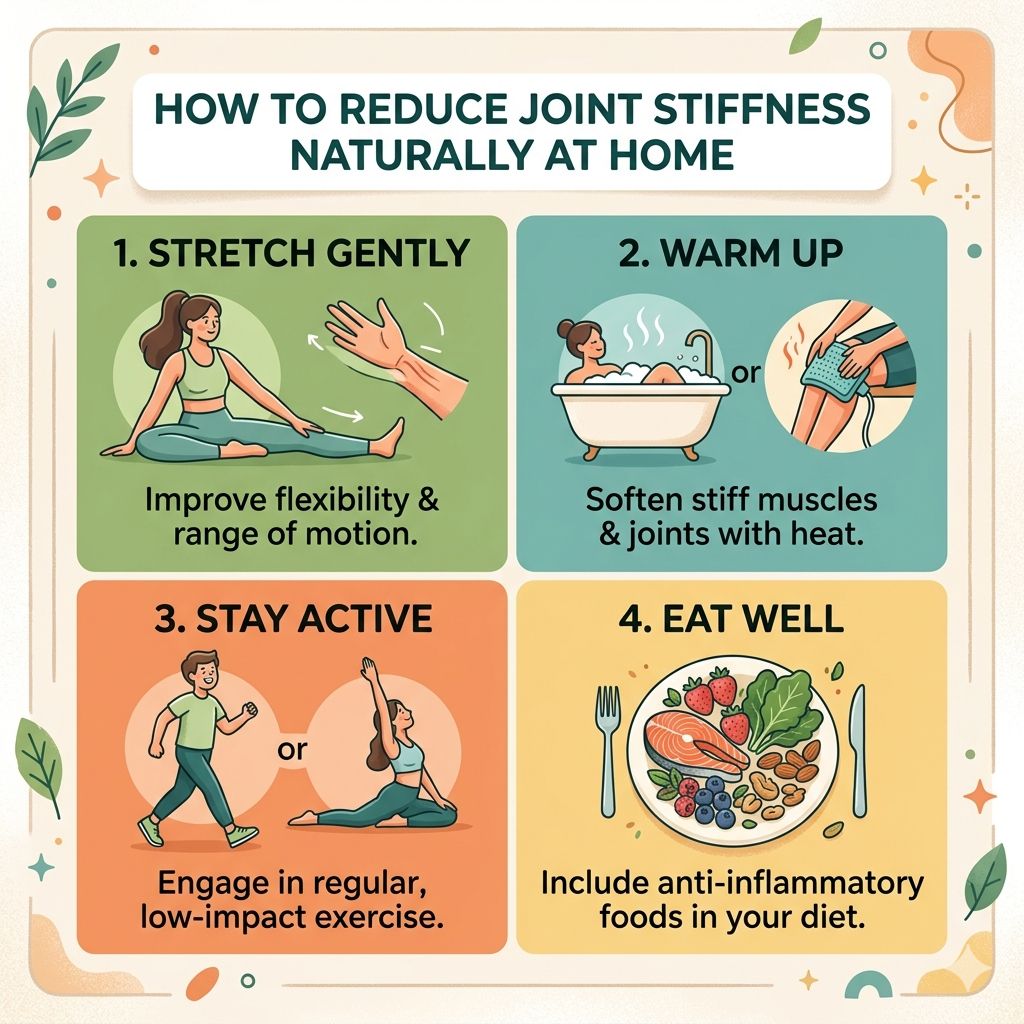
1. Gentle Morning Movement (Before You Fully Wake Up)
One of the most powerful natural ways to reduce stiffness is early gentle movement.
You don’t need intense exercise. You need activation.
Try:
- Slow neck rotations
- Shoulder rolls
- Gentle knee bends
- Ankle circles
- Light stretching in bed
This signals the body to:
- Increase circulation
- Activate synovial fluid
- Loosen joint capsules
Think of it as waking up your joints before waking up your day.
2. Warm Water Therapy to Loosen Tight Joints
Warmth is one of the simplest natural therapies for stiffness.
Heat helps by:
- Increasing blood flow
- Relaxing tight muscles
- Improving joint flexibility
- Reducing pain sensitivity
At home, you can use:
- Warm showers in the morning
- Warm compress on stiff joints
- Warm foot baths for lower limb stiffness
Even 10–15 minutes of warmth can make movement noticeably easier.
3. Stay Moving During the Day (Don’t Freeze Your Joints)
One of the biggest drivers of stiffness is prolonged stillness.
When you stay in one position too long:
- Circulation slows
- Joints “lock up”
- Muscles tighten around joints
Simple solution: movement breaks.
Every 30–60 minutes:
- Stand up
- Stretch gently
- Walk for 2–5 minutes
- Rotate stiff joints
The goal is not intensity. It is consistency of motion.
4. Hydration: The Forgotten Joint Lubricant
Joints depend heavily on fluid balance.
When you are dehydrated:
- Synovial fluid becomes less efficient
- Cartilage loses elasticity
- Movement feels more restricted
Even mild dehydration can increase stiffness.
A simple habit:
- Drink water consistently throughout the day
- Start your morning with a glass of water
- Add natural electrolytes if needed (like lemon or mineral-rich foods)
Think of water as internal joint lubrication support.
5. Anti-Inflammatory Nutrition to Calm Internal Tightness
Stiffness is often fueled by inflammation inside the body.
Certain foods can either worsen or reduce this process.
Helpful anti-inflammatory foods include:
- Leafy greens
- Ginger
- Turmeric
- Garlic
- Berries
- Healthy fats (like olive oil, avocados, nuts)
Foods that often worsen stiffness:
- Excess sugar
- Deep-fried foods
- Highly processed meals
- Refined carbohydrates
You are not just feeding your stomach—you are feeding your joint environment.
6. Heat + Movement Combination (The Natural Reset Button)
One of the most effective home strategies is combining: 👉 warmth + gentle movement
Example routine:
- Warm shower or compress
- Gentle stretching while warm
- Light walking or mobility exercises
Why this works:
- Heat loosens tissues
- Movement spreads lubrication
- Together they “reset” stiffness faster
This combination mimics what physical therapy often aims to achieve.
7. Herbal Support for Joint Comfort
Nature offers plant-based support that helps calm inflammation and improve mobility over time.
Common supportive herbs include:
- Ginger – improves circulation and reduces stiffness
- Turmeric – supports anti-inflammatory pathways
- Boswellia – helps joint comfort and mobility
- Moringa – supports overall tissue nourishment
These do not force the body. They support balance gradually.
8. Stress and Emotional Tightness in the Body
Not all stiffness is physical.
Chronic stress creates:
- Muscle tension
- Reduced circulation
- Heightened pain sensitivity
The body under stress stays in a “protective mode,” which often feels like stiffness.
Helpful practices:
- Deep breathing
- Quiet reflection
- Meditation or prayer
- Journaling
When the nervous system relaxes, the body often follows.
9. Weight and Joint Pressure Balance
Excess body weight increases mechanical stress on joints—especially knees, hips, and ankles.
Even small reductions in weight can:
- Improve mobility
- Reduce stiffness
- Decrease inflammation load
But the goal is not pressure—it is balance over time.
10. Consistency Matters More Than Intensity
Reducing joint stiffness naturally is not about one big action.
It is about:
- Daily movement
- Daily hydration
- Daily nourishment
- Daily awareness
Small habits repeated consistently create long-term change in how joints feel and function.
Buy Nurturing Self-care Practices for Healing: A 12 Week Program For Optimal Healing by Alfred Okoko on Selar https://share.google/ydpRFnSbDECSkusTC
What Your Body Is Really Asking For
Behind stiffness, the message is often simple:
- “Move me gently.”
- “Support my circulation.”
- “Reduce internal inflammation.”
- “Don’t keep me still for too long.”
Your body is not resisting you. It is responding to conditions.
When conditions improve, stiffness often softens.
Final Reflection: Movement Is Medicine for Stiff Joints
Joint stiffness is not a life sentence—it is a signal.
And signals can be responded to.
When you:
- Move gently
- Hydrate well
- Reduce inflammation
- Warm the body
- Support stress balance
…the body begins to respond with ease instead of resistance.
Healing stiffness is not about forcing joints to obey.
It is about creating an environment where they feel safe to move again.
Learn how to reduce joint stiffness naturally at home using simple daily habits like gentle movement, hydration, anti-inflammatory foods, warmth therapy, and herbal support for better mobility and comfort.
 Wordplant Living System